
Weeks 1 – 6, General Lectures [Oct 2 – Nov 7]
- Six alternating physics and philosophy talks
- 40 minute talks followed by 10 min Q&A period (with a 10 min break in between)
- Light sacks and beverages provided (agora theme)
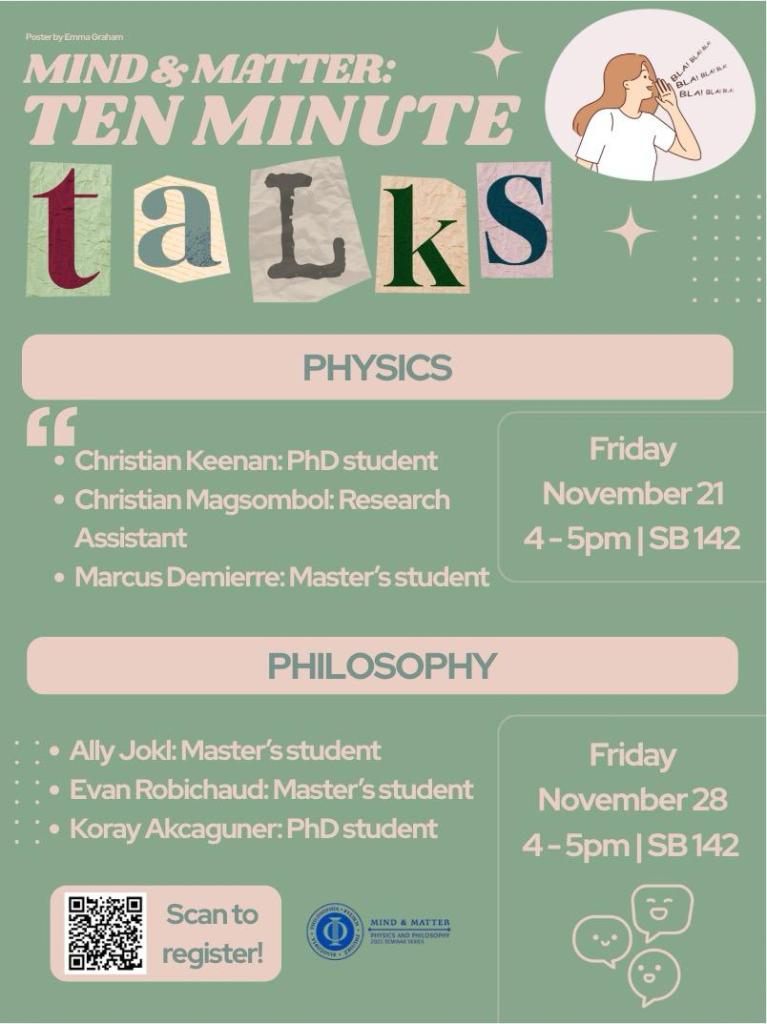
Weeks 7 & 8, Graduate Students Presentation [Nov 21, 28]
- Two sessions dedicated to graduate student research presentations
- Four 10 minute talks followed by 3 min Q&A periods
- Light snacks and beverages provided (agora theme)
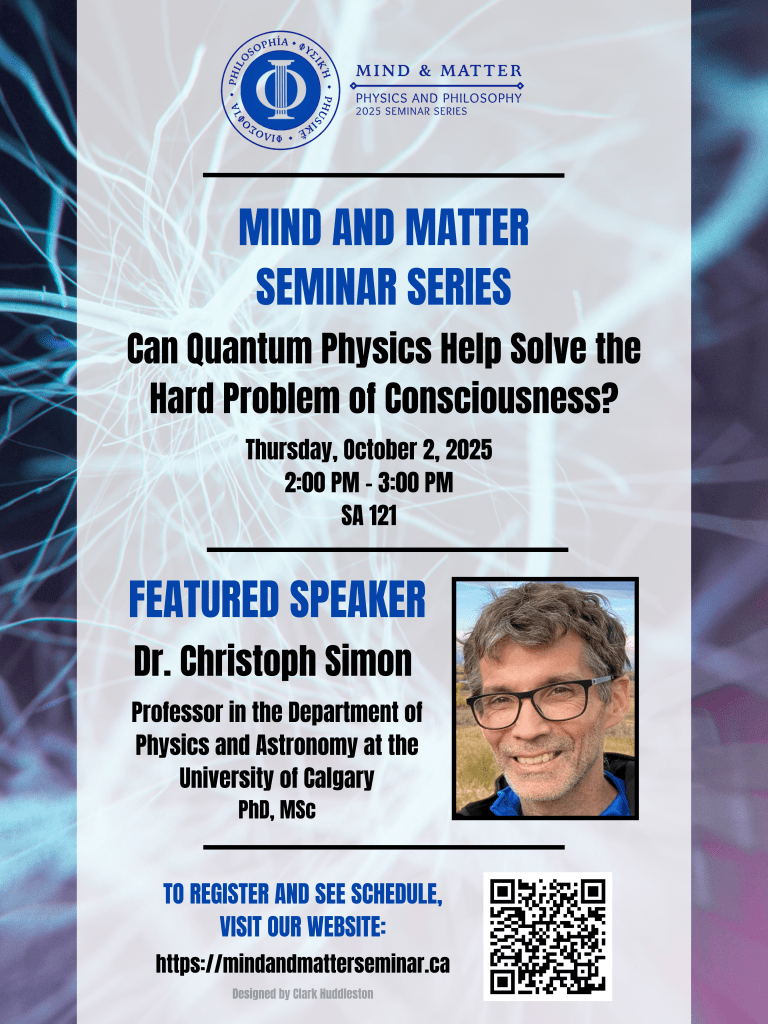
Week One – Can quantum physics help solve the hard problem of consciousness?
When & Where: Thursday, October 2nd, SA 121, 2-3 pm MST
Abstract: The hard problem of consciousness is the question of how subjective experience arises from brain matter. I suggest that quantum physics may be part of the answer. The simultaneous unity and complexity of subjective experience is very difficult to understand from a classical physics perspective. In contrast, quantum entanglement is naturally both complex and holistic. Building on recent remarkable progress in quantum technology and neuroscience, I propose a concrete hypothesis as a basis for further investigation, namely that subjective experience is related to the dynamics of a complex entangled state of spins, which is continuously generated and updated through the exchange of photons. The proposed hypothesis raises many interesting experimental and theoretical questions in neuroscience, biology, chemistry, physics, computer science, psychology, and philosophy. In the second part of the talk, I will provide some updates on our recent related work in quantum biology and quantum neuromorphic computing.

Dr. Christoph Simon is a professor in the Department of Physics and Astronomy at the University of Calgary, where he is a member of the Institute for Quantum Science and Technology and of the Hotchkiss Brain Institute. He has devoted his career to the study of quantum entanglement and its applications. In recent years a lot of his research has been motivated by the question in the title of this talk.
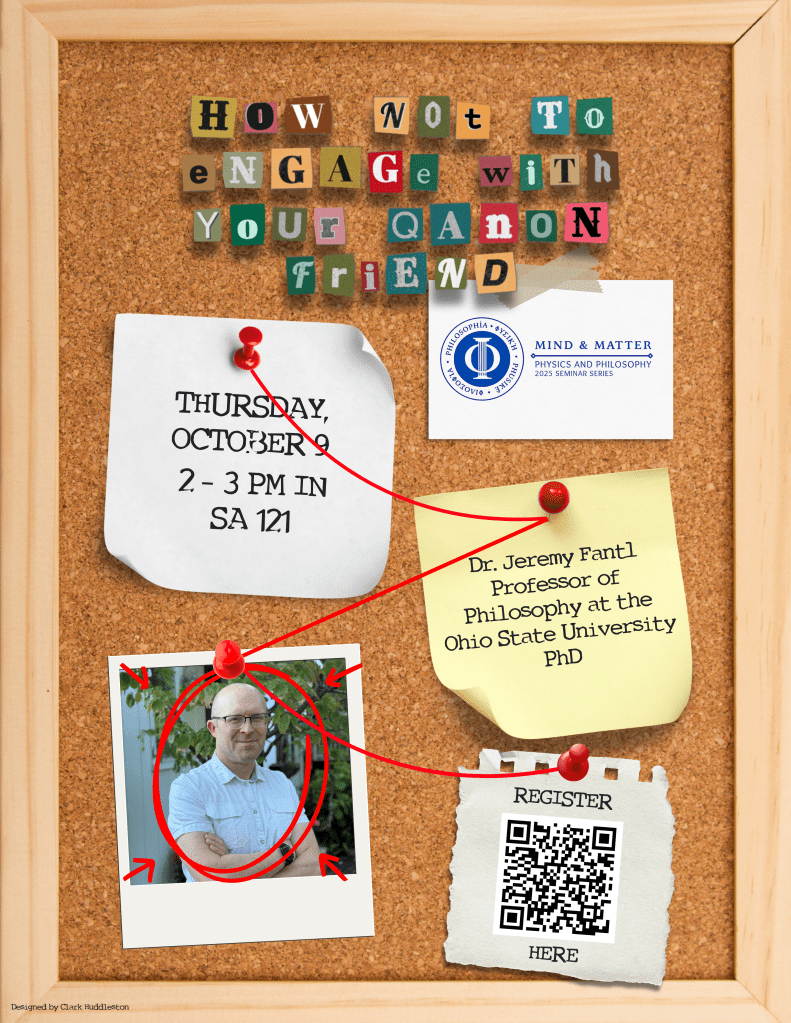
Week Two – How Not to Engage with Your QAnon Friend
When & Where: Thursday, October 9th, SA 121, 2-3 pm MST
Abstract: Sometimes you can know controversial things: propositions that significant numbers of people disagree with. How should you respond when, despite this, a family member or friend is bent on convincing you that you’re wrong? I argue for two conclusions: first, your attitude toward any arguments your friend offers, when you know you’re right, should be closed-minded. You should be unwilling to reduce your confidence in response to your friend’s arguments, even if you can’t figure out where those arguments go wrong and all the steps seem individually compelling. Second, because of this, you often shouldn’t engage with your friend for the purpose of changing their mind. You shouldn’t engage open-mindedly, because your appropriate attitude is closed-minded. And you often shouldn’t engage closed-mindedly: either you will end up hiding your closed-mindedness, which can be problematically deceptive and manipulative, or you will be honest about your closed-mindedness, which can be ineffective.

Dr. Jeremy Fantl is a Professor of Philosophy at the Ohio State University, but worked at the University of Calgary from 2006-2024, and received his PhD in Philosophy from Brown University. He has also spent time in the Philosophy Departments at Brandeis University and the University of Arizona. He is co-author with Matthew McGrath of a number of publications on the relationship of knowledge to action. Most recently, he has been working on the nature and worth of open-mindedness and defending traditional epistemology against the charge that it can’t be helpful in guiding inquiry and action.
Outside of philosophy, he cares to an unhealthy, sleep-depriving extent about the fates of four Boston-area sports teams, in the following order of importance: 1) Red Sox, 2) Patriots, 3) Celtics, and 4) Bruins.
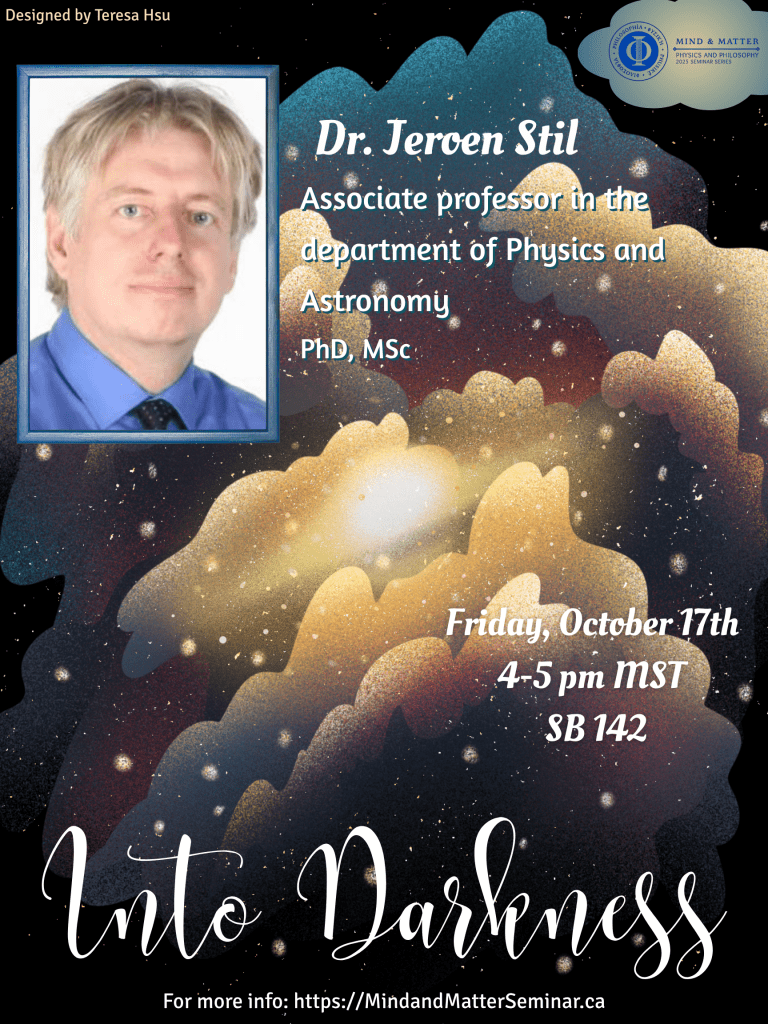
Week Three – Into Darkness
When & Where: Friday, October 17th, SB 142, 4-5 pm MST
Abstract: Imagine a sky with no stars. Whatever direction you look, you see nothing. Take a random position in the universe, and this is what the sky most likely appears to you: starless and dark. Why is this so different from the sky we know? For sure, some of the explanation must be sought in the limits of the human eye. What if we could see in the infrared? There would be no darkness underground. If we consider this, then stars form in a darkness that is more profound than that of the deepest cave on Earth. Similarly, the starless sky in a random point of the universe tells us something fundamental about the structure of the universe. Yet, if we overcome the limitations of our own eyes, the universe is not as dark as it appears.

Dr. Jeroen Stil obtained his MSc from the University of Leiden (Leiden Observatory), The Netherlands, in 1993 with a thesis on X-ray Spectroscopy of the supernova remnant Cas A. In 1999 he received his PhD from Leiden University with a thesis about atomic hydrogen in dwarf galaxies. In September 1999 he moved to Canada for a postdoc at Queen’s University working with the Canadian Galactic Plane Survey. In 2001 he moved to Calgary, initially as research associate and since 2008 as assistant/asoociate professor. Research interests include cosmic magnetism, the interaction of stars and active galactic nuclei with their environment, and radio astronomical surveys. Jeroen Stil is a long-term proponent of the international Square Kilometre Array Observatory that Canada formally joined in 2024.
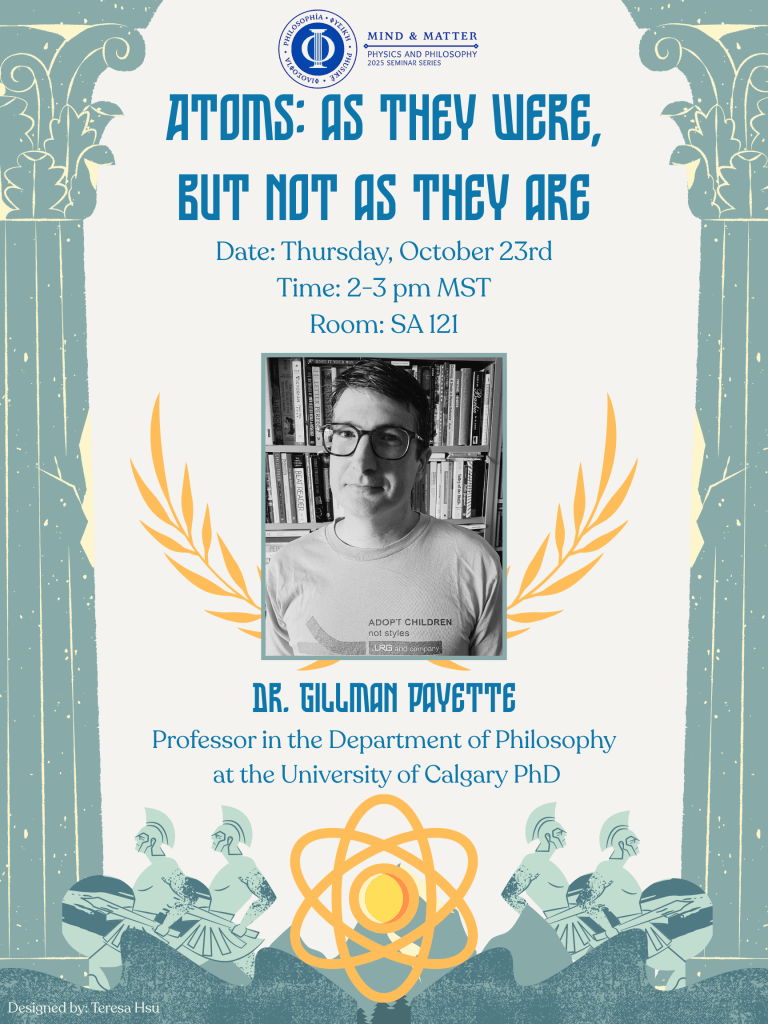
Week Four – Atoms: as they were, but not as they are
When & Where: Thursday, October 23rd, SA 121, 2-3 pm MST
Abstract: We will look at a few topics in ancient Greek atomism. It was perspective developed over a number of centuries within the Greek philosophical tradition. It would fall out of fashion for awhile and then gain traction again. Some have argued that the rediscovery of a particular work from that tradition helped the scientific revolution along.
We will look, in particular, at two topics: 1) why they thought there were atoms and what they thought atoms were like, and given that description 2) a reason why the view can’t be right, but how that objection might be overcome in a way the atomists wouldn’t like.
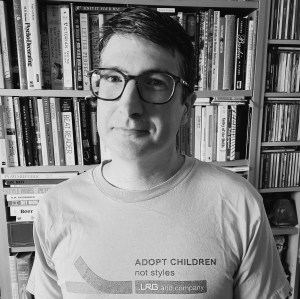
Dr. Gillman Payette is a professor in the Department of Philosophy at the University of Calgary. His research and teaching have taken him from Dalhousie University, UBC, U of L, U of A, and, finally, to the University of Calgary over a decade after completing a PhD there. There was also a short stint as a policy analyst as a MITACS Canadian Science Policy Fellow for the BC provincial government.
While his research has focused on logic, its philosophy, and its applications (to philosophical problems in ethics, action, and epistemology), this talk represents a more recent interest in ancient philosophy and in particular Epicureanism.
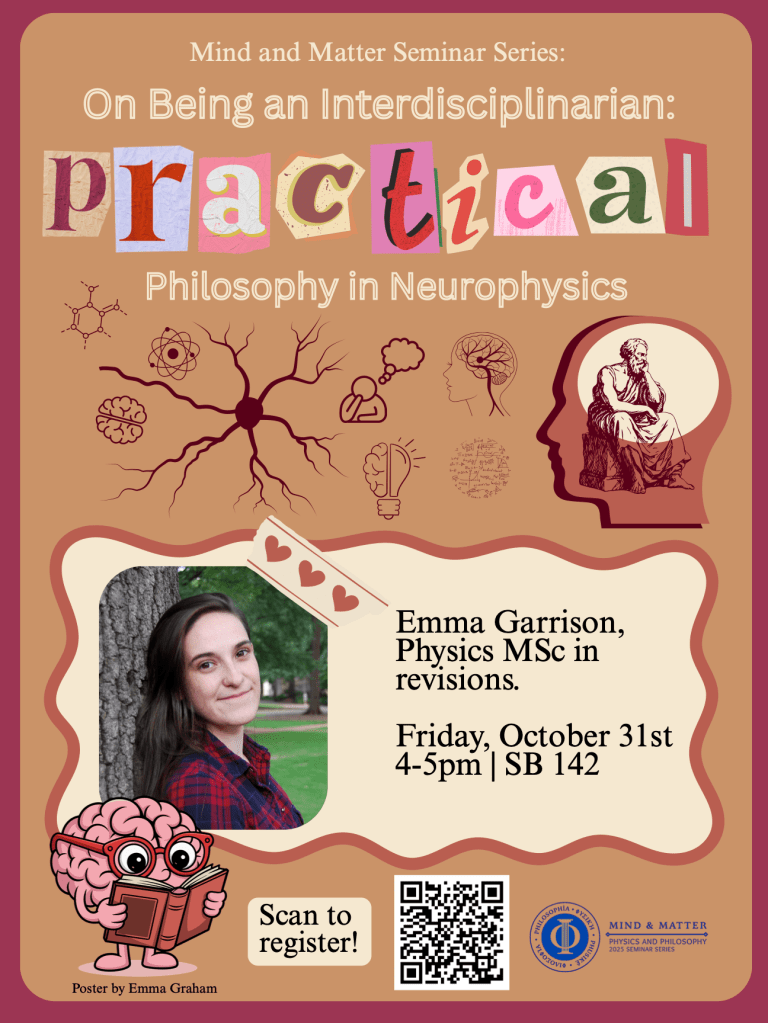
Week Five – On being an interdisciplinarian: practical philosophy in neurophysics
When & Where: Friday, October 31st, SB 142, 4-5 pm MST
Abstract: Interdisciplinary work in science is a popular pursuit and often a buzzword in blurbs and bios. However, probing a little deeper into the philosophy of science reveals pitfalls and traps rarely addressed in the day-to-day practice of science. Disciplines in science have large gaps between their individual practices and assumptions that feel, on occasion, somewhat insurmountable. This, however, is the mission of the interdisciplinarian. This talk endeavours to discuss the gap between philosophical principles and practical interdisciplinary science through my experiences in neurophysics. Why is interdisciplinary science important – practically and philosophically? How are the practices and assumptions of a fundamentally interdisciplinary field like neurophysics informed by philosophy? What is the state of parity and collaboration between disciplines in the field? If interdisciplinary science is key to understanding more about the world around us, not only must one bridge the gap between scientific disciplines like neuroscience and physics, but also incorporate philosophy into scientific practice.

Emma Garrison is currently completing revisions for her MSc in Physics at the University of Calgary. Her thesis is on the long-term dynamics of human brain networks across the lifetime. Emma received two undergraduate degrees from the University of South Carolina – a BSc in Physics and a BSc in Psychology. While in South Carolina, she also completed an honors thesis on the philosophy of interdisciplinary science. Emma is extremely passionate about interdisciplinary work in academia. Beyond science, Emma has many interests. As a self-proclaimed hobbyist, she can be found spending her free time learning a new skill, from painting to woodworking to bird watching. She also loves reading books, playing DnD, and occasionally, doing some community theatre.
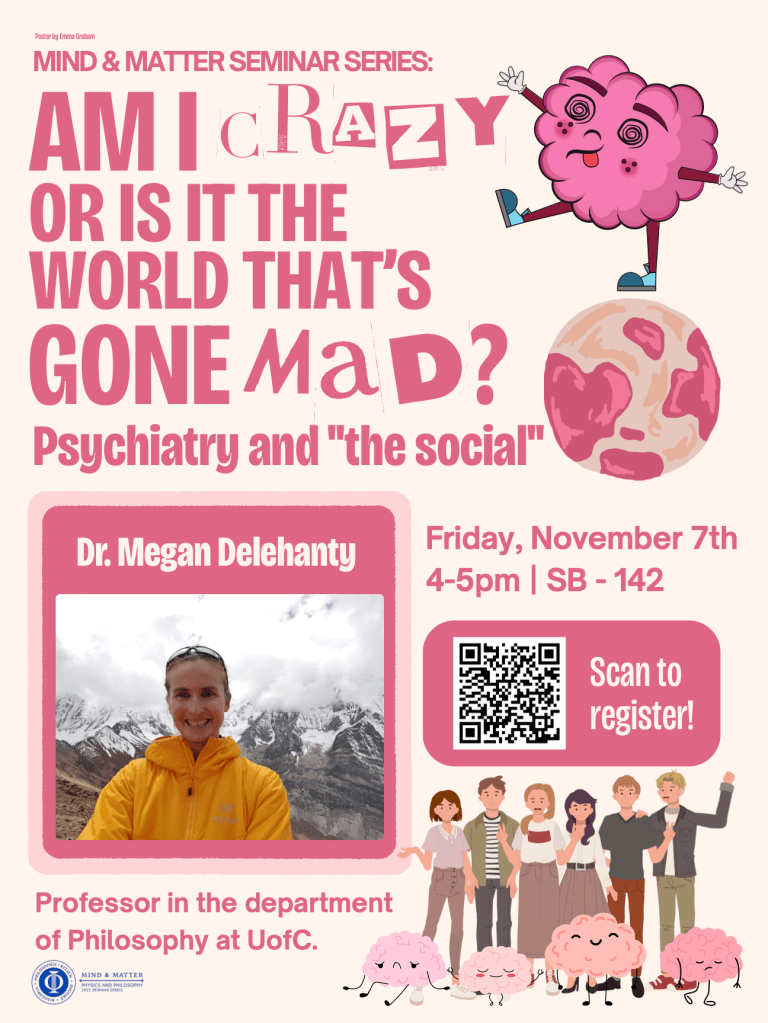
Week Six – Am I crazy, or is it the world that’s gone mad? Psychiatry and “the social”
When & Where: Friday, November 7th, SB 142, 4-5 pm MST
Abstract: We all have bad mental health days – increasingly so, for many of us – but not all of us have mental disorders (or are mad or are neurodivergent). What distinguishes normal responses to adversity from abnormal or pathological responses? For instance, when does normal grief following a significant loss become something that mental health professionals might label as a mental disorder? Are the difficulties that an autistic person experiences due to pathology or to an environment that isn’t a good fit for them because it’s designed to meet the needs of neuronormative people? The idea that mental illness involves “broken brains” is very common, and our understanding of the complex genetic bases and neurobiology of mental disorders has increased in recent decades. But so has our recognition that social factors such as poverty, food insecurity, inadequate housing, discrimination, and lack of social support play an important role in the causation and perpetuation of mental disorders. These social determinants of mental health are embedded within larger geopolitical systems that, arguably, play an even larger role though their influence on these social factors. If someone experiences serious and sustained emotional distress while living under terrible political, economic, and social conditions – conditions under which it seems no “normal” human could thrive – does it make sense to diagnose them with a mental disorder? In this talk, we’ll look at how we might try to answer this question.

Dr. Megan Delehanty is a professor in the Department of Philosophy at the University of Calgary. After doing undergraduate and graduate degrees in Microbiology (at the U of A and UBC), she changed fields and completed a PhD in History and Philosophy of Science at the University of Pittsburgh. She then got a job at the University of Calgary and was very happy to be able to return to Canada. Her research initially focused on philosophical problems with complex imaging technologies in biology and medicine. More recently, she has been interested in issues in philosophy of psychiatry and psychotherapy.
Her cat Pyxis is also a philosopher.
Week Seven – Graduate Student Posters
Physics Talks
When & Where: Friday, November 21st, SB 142, 4-5 pm MST
Speakers:
Christian Keenan – PhD Student
The Earth is surrounded by a magnetic field, which is a protective barrier against the constant bombardment of radiation and energetic particles from the Sun, known as the solar wind. When the solar wind reaches the Earth’s magnetic field, it distorts it and creates a teardrop-shaped magnetic cavity called the magnetosphere. The magnetosphere is a highly dynamic environment that consists of high-energy particle populations. The interactions between the Sun, solar wind, and magnetospheric particle populations contribute to a phenomenon known as space weather. Space weather can significantly impact the performance of modern technology and infrastructure. For instance, space weather has adversely affected electrical power grids and pipelines, as well as satellite-based systems such as GPS, communications, and other satellite services. It is estimated that extreme space weather events could cause power blackouts that might lead to damages exceeding one trillion dollars in the first year alone (National Research Council, 2008).
As society’s reliance on space-based technology continues to grow, accurate space weather forecasting models are desperately needed to help mitigate the harmful impacts of space weather. Although relevant data collection and modelling have been undertaken for decades, the complexity of near-Earth space prevents scientists from coming to a complete understanding of the system. The current approach to studying the near-Earth space system is to divide it into smaller sub-systems, which can be studied in detail. This enables a deeper understanding of the sub-system, which can be applied to studying the dynamics of the larger system. Of particular interest to me is energy transfer between the magnetosphere and the Earth’s atmosphere. This energy transfer is essential to a comprehensive understanding of both atmospheric and magnetospheric dynamics, and can be applied to predictive space weather models. The University of Calgary’s Space Remote Sensing (SRS) group offers a wide range of ground-based data sources that are crucial for studying the essential energy transfer processes between these two systems. My research aims to identify unique characteristics of magnetosphere-atmosphere energy transfer processes using the various data sources provided by the SRS group. The overarching goal of my work is to gain a better understanding of the impacts this energy transfer has on the magnetospheric system as a whole
Christian Magsombol – Research Assistant
Carbon fiber-reinforced carbon matrix composites, or carbon-carbon composites, are lightweight, high-strength, high-stiffness materials used where structural stability at extremely high temperatures is critical. These materials are best known for their applications in thermal shielding for rockets and atmospheric re-entry vehicles, aircraft braking systems, and jet-propulsion combustion chambers. State-of-the-art carbon-carbon composites are produced from carbon fiber fabrics impregnated with resin polymers, which exhibit low carbon yields upon pyrolytic carbonization. Thus, to achieve the carbon densities required for component structural integrity, several cycles of carbon infiltration and pyrolysis are needed, making the manufacturing process both labor and time-intensive and resulting in very high costs. Recently, efforts have been made to produce complex carbon-carbon components from additively manufactured composite precursors, enabling fine control over fiber placement to achieve structural optimization and reduced mass. The Laboratory of Engineering Materials at the Schulich School of Engineering has developed a novel process for producing carbon-carbon composites by applying simultaneous heat and pressure to additively manufactured thermoplastic composites to stabilize the polymer matrix prior to carbonization, resulting in a carbon-carbon composite that exploits the strength of continuous fiber reinforcement.
Marcus Demierre – Master’s Student
Quantum mechanics as a theory of reality has existed for a little over a century, and yet its
insights have radically changed the way we interact with the world. It is currently spawning a wholly new technology, quantum computing, whereby the ”bits” of classical computers are replaced with quantum analogues called qubits. In doing so, quantum computing unlocks tremendous advantages over our current computers, in areas such as cryptography – annihilating our present encryption methods while also giving us a method of provably secure communication – and in performing microscopic simulations, among many other things. In this sense, our development of this technology requires us to accept this strange new world that is so unlike what we are accustomed to, and to boldly venture forth and embrace the strangeness of the universe to reap all the benefits that come with doing so. Consequently, I believe a connection can be made between the pursuit of quantum computing and the philosophy of existentialism, which deals with subjects like the detachment between ourselves and the universe which surrounds us, and how we should proceed under such knowledge. For my presentation, I will discuss quantum computing, and how it pertains to things like Camus’ notion of the absurd, and mankind’s choice to live authentically in the universe despite how alien its inner workings may seem. This will help to illustrate the philosophical significance of quantum mechanics and computing, and how it connects to the broader philosophical positions we currently find ourselves in.
Philosophy Talks
When & Where: Friday, November 28th, SB 142, 4-5pm MST
Speakers:
Ally Jokl – Master’s Student
External world skepticism – at least, of a certain sort – holds that knowledge must be
infallible. Barry Stroud (1984) presents one version of the infallibilist skeptical argument.
He argues that knowledge requires that you rule out all possibilities of error. We can’t rule
out lots of possibilities of error, like that you are being deceived by an evil demon, so we
cannot know about the external world.
Relevant alternatives theories are one type of response to skepticism. Relevant alternatives theorists deny that knowledge requires that we rule out all possibilities of error. Rather, knowledge requires that we rule out possibilities of error that are relevant in some way. Relevance theories differ in how they determine what makes a possibility of error relevant. Most major relevance theories do not exclude, in all cases, skeptical possibilities.
I am convinced by relevant alternatives theorists that knowledge requires that we rule out
relevant possibilities of error. I am not convinced that we should concede to the skeptic that skeptical scenarios should ever be relevant to knowledge.
I argue that we can resolve the worst problems presented by skepticism by adopting the
principle of Calculable Probability (CP). CP holds that a possibility of error is relevant to
knowledge only if there is a procedure for calculating the probability that that possibility
obtains. CP gives a necessary condition that possibilities of error must fulfil to be relevant
to knowledge. Adopting CP solves skepticism because, according to CP, skeptical scenarios like evil demons are excluded from the relevant domain.
Evan Robichaud – Master’s Student
Among those who accept that perception is best thought of as having representational content, there is a debate over whether these contents are singular or general. If perception has singular contents, then it represents particular seen objects in a manner unmediated by general properties. In other words, the perceptual representation essentially involves the objects represented. Alternatively, if perception is purely general, it only contains general contents like properties. On this view, any perceptual representation of an individual will be alike to a description. One way of trying to decide on this question is to look at the scientific literature. Some have cited studies in visual object tracking to support the view that perceptual contents are singular in nature. If this view is correct, then perceptual content cannot be exclusively general. The argument starts by showing that we have a perceptual capacity to track multiple objects over time despite changes in their properties. The object tracking objection to generalism about perceptual content says that there is no one description that can capture what is represented in visual object tracking because visual object tracking persists despite changes in the properties of objects. Contrary to this view, I argue that studies in visual object tracking supports generalism about perceptual contents. This argument says that only generalism can explain how certain illusions will obtain in perceptual object tracking. Studies of illusory apparent motion, ternus displays, and studies on perception of streaming vs. bouncing all require positing general contents to explain illusory cases. In these cases, there is indeterminacy as to which object is falsely represented as in motion or as tracked over time. I conclude that studies in object tracking support the view that the contents of visual object tracking is general.
KorayAkcaguner – PhD Student
Constructivism in the philosophy of mathematics holds that mathematics is a free creation of the human mind. Toward the end of the 19th century, several mathematicians and philosophers realized that parts of classical mathematics were incompatible with this view — that they were not genuinely mathematical, but rather metaphysical. They restricted certain classical principles and introduced new ones, giving rise to constructive mathematics. Here, a mathematical object exists only insofar as it is constructed, and not everything that exists in classical mathematics can be claimed to exist constructively.
With the rise of computation theory in the 1930s, constructivism took a computational turn: mathematical objects came to be understood as computable ones. The limits of con-
structability became the limits of computability, and constructive mathematics evolved into what is now called computable mathematics. This shift, however, introduces a fascinating tension. Our most familiar models of computation, such as Turing machines, may themselves rely on assumptions about the physical world. Some have argued that Turing machines are effectively Newtonian devices and proposed theories of relativistic computers, which could in principle, compute far more. If the limits of computation depend on our understanding of physics, and constructivists take these limits to define mathematical existence, then mathematical existence itself may be sensitive to our understanding of physics.
I will outline this intriguing situation and discuss some of its philosophical implications.
 Physics & Philosophy Seminar Series